
If you want to work with digital competences in one way or another, you might want to take a look at the “Digital Competence Framework for Citizens” developed by EU’s Joint Research Centre.
The DigiComp framework is designed to provide a shared understanding of what digital competence is. Since its launch back in 2013 the framework has become a reference tool for digital competence initiatives across Europe. It functions both as a support for the formulation of policies, the development of concrete education and training initiatives as well as an assessment tool for individual digital competences.
Digital competence is one of the eight identified key competences for lifelong learning (see more here) and the DigiComp framework describes digital competence as a combination of knowledge, skills and attitudes operationalized in 21 competences grouped into five main competence areas.
DigiComp conceptual reference model:
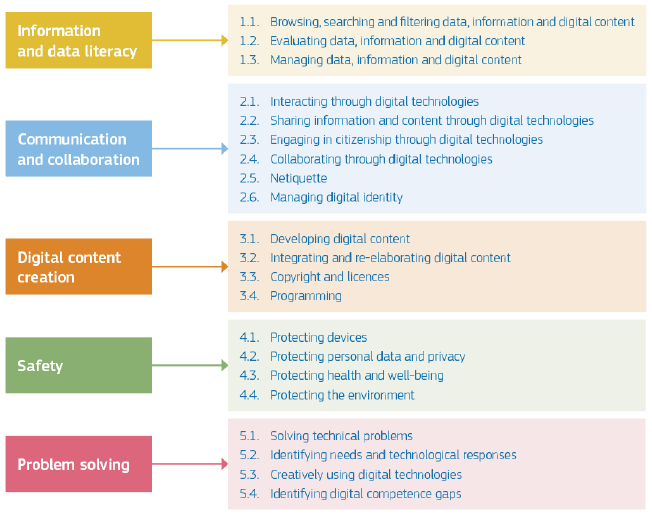
A framework for project development
With the latest 2022 update to version 2.2. that added an extensive body of examples we now have a rather elaborated outline of each competence. Thus, each competence, for example 3.4 “Programming”, is described in terms of proficiency level, examples of knowledge, skills and attitude as well as user cases. This makes the DigiCom framework a valuable tool for international collaboration on education such as ERASMUS cooperation partnerships, including the sharing of good practice, development of blueprints and sector skills or as a basis for the development of teaching materials or the design of education and training programmes.
Take a look at the latest DigiCom 2.2 here: https://joint-research-centre.ec.europa.eu/digcomp_en
Key reference documents:
Supporting resources
Further, the DigiCom is supported by a number of resources that can be incorporated in your project to support the activities or strengthen the implementation of your project:
Europass. Digicom is incorporated into Europass CV. This allows users to list and organise their digital skills in the Europass Profile following the DigiComp model.
Self-assessment tool on Digital Skills and Jobs Platform. The framework is also incorporated into the Digital Skills and Jobs Platform, where any EU citizen can access a self-assessment tool on digital competence.
DigCompSat. A self-reflection tool for the Digital Competence Framework, where citizens can assess all the 21 DigiComp competences corresponding to proficiency levels 1 to 6 (foundation, intermediate and advanced). Report (2020): data.europa.eu/doi/10.2760/77437
MyDigiSkills. An online tool that allows citizens to self-reflect on their digital competence using the DigCompSat. The test is available in 11 languages on the website: mydigiskills.eu
Digital Skills Index Since 2015, the European Commission has monitored the level of EU citizens’ digital activities using the Digital Skills Index (DSI) that is based (on the) on the five competence areas in the DigiCom framework website: ec.europa.eu/eurostat/cache/metadata/en/tepsr_sp410_esmsip2.htm
DigComp Certification work. A community of practice has also been created in order to support the design and development of the European Digital Skills Certification (EDSC) Feasibility (s)Study, and its eventual consultation and participation processes. (Website: all-digital.org/certification-cop
Digital competences for educators and educational institutions
Digital competences for educators and educational institutions
Digital Competence is not only a pressing issue for the development of our education and training. Educators across the education and training system face a similar need to develop their digital competence in order to be able to provide relevant education and training and to guide children and students, as well as make the best use of the technology themselves for teaching, learning and assessment.
To support the digital competence building for educators in a professional context, the JRC has developed at specific Digital Comptence Framework for Educators (DigiCompEdu), see https://publications.jrc.ec.europa.eu/repository/handle/JRC107466

Further, a European Framework for Digitally Competent Educational Organisations (DigCompOrg) has been developed to support capacity building within an educational organization as a guide to the integration and effective deployment of digital learning technologies.

 SDEO Education