
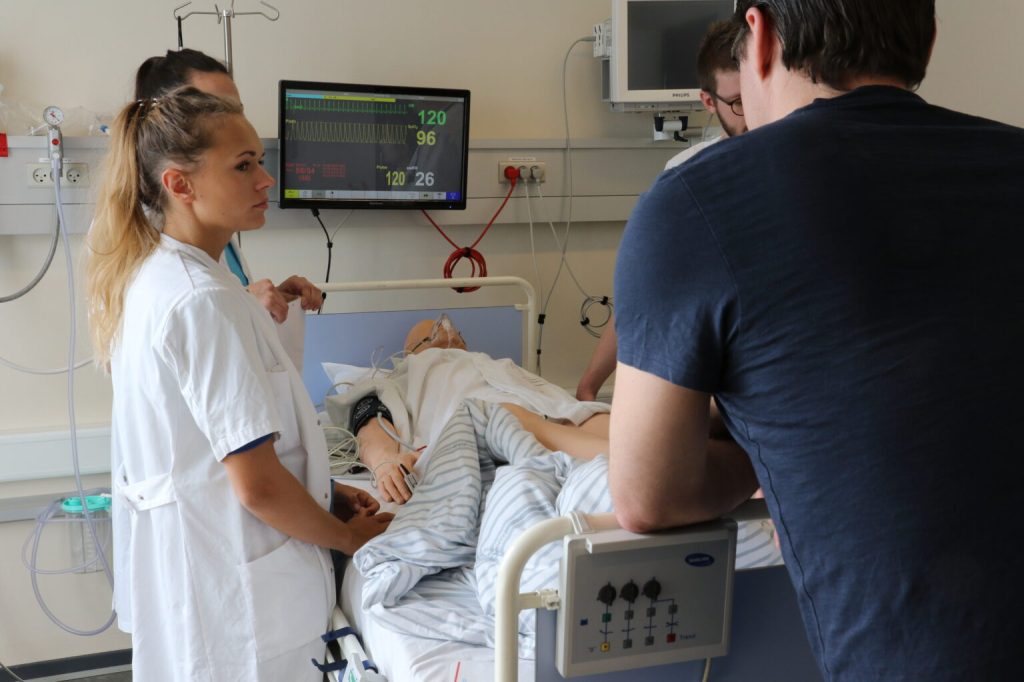
The hospital system is changing. Patients are hospitalized for a shorter time, and more of the treatment takes place on an outpatient basis. This is good news for all of us, but it creates a challenge for future healthcare personnel, who must have clinical experience with patients during their education. That is why OUH (Odense University Hospital) and SDU (University of Southern Denmark) have teamed up with four European partners in a new EU project to investigate how to create new types of clinical courses in the health sector.
How do you ensure that future health professionals get the right practical experience in hospitals when patients are hospitalized for a shorter time? This is the challenge that a new EU project with the title HEAL (internsHips in futurE hospitALs) is clearly addressing. The project is supported with DKK 2.9 million DKK from the Erasmus+ programme.
“How do we solve the huge educational task that arises when hospitals move from having fewer inpatients, while the number of students on health education programs increases? The project will examine how we can better accommodate all those seeking further education and at the same time ensure that they get a really good education,” says Lene Just, education consultant and professional coordinator at OUH.
Treatment and education at once
The project started at the end of February 2022 and will run for three years. HEAL focuses on nursing education and medical studies and will also involve the students in the process. Through the project, the partners must take a closer look at how the practical part of health education can be thought of in new ways.
“Right now, you have to see patients in order to call it a real ‘clinic’, and that’s what we have to investigate, after all. We talk about learning before, during and after. In the clinic, we are really good at what is “below” – that is, where we are with the patient. In this project, we also want to find out whether with better preparation and post-processing we can create even more learning in the meeting with the patient,” elaborates Anna Skat Nielsen, chief of staff, OUH. Karin Shung Albjerg, head of education, OUH, adds:
“The students will also become active players in the project. It is important to hear what they find works when we try to organize their internship in new ways.”
A pan-European challenge
In addition to OUH and SDU, the HEAL project consists of three European universities; Maastrict University in the Netherlands, Trinity University College in Ireland, Haute Ecole Libre Mosane in Belgium and the German Trias University Hospital in Pujol University Hospital in Spain.
The interaction between the different countries is an important force in HEAL, as the challenge of ensuring clinical processes in the hospitals is the same throughout Europe.
“We would like to treat as much as possible at home – it is also best for our patients. But it does something for the possibility of being able to offer treatment and education at the same time. And it is particularly interesting in a European context, because it is a movement that we can see all over Europe,” explains Anna Skat Nielsen. Lene Just adds:
“There is also a strength in the fact that there are more of us who have to test some things. This gives us more experience than we would be able to create on our own. Because it’s not because we haven’t focused on this before. The challenge has been there for a while, but when there are more of us, we can test more things, and that is a strength.”
The challenge is the same across Europe and that became evident in the application process, where the partners experienced great interest in the project. According to Anna Skat Nielsen, this is both because the need for a solution extends beyond Denmark’s borders, but also because the project presents a new way of working.
“It is a need that many can see, but for which we, neither nationally nor internationally, have yet found the best solution. Therefore, the project also requires that we have to work with the needs first before we work on a solution. As with everything else, when we work in the healthcare system, we have to get a handle on the problem and the cause before we can create solutions,” she concludes.
The South Denmark EU office played an active role when the application for the HEAL project was created. Among other things, by organizing a creative workshop with OUH and SDU, contributing to the development of the project and creating contact with relevant partners in the participating countries. Henriette Hansen, SDEO’s EU consultant in the area of health and welfare, says:
“Together with OUH, we experienced a very intensive month and a half, during which the project idea, partnership and application came into place. With close, active, and creative collaboration, much can be done, and we proved that. I am now looking forward to following the project’s development over the next three years.”
If you want to know more about the Erasmus+ program and the possibilities for support within the health sector, you are welcome to contact EU consultant Henriette Hansen at hha@southdenmark.be.

 SDEO Education