
How do you ensure that education and industry go hand in hand within the dairy sector? This is one of the questions behind the EU project European Excellence in Dairy Learning. With a financial boost of 29 million DKK from the Erasmus+ programme, the project will investigate how to improve cooperation between dairy companies and education programmes across Europe.
Increased globalisation, accelerating technological development and an urgent need for a green transition. These are some of the challenges facing Europe across sectors.
This also applies to the dairy sector, where the development has created a great need for digital and green skills – and this is precisely where the new EU project will come into play. With the Association of Dairy Managers and Clerks at the helm, the project will collaborate with Kold College, University College Lillebælt, the University of Copenhagen and partners from ten other countries with a common goal of ensuring that European dairy education programs keep up with the needs of the industry. This is done with support from the EU’s new flagship within vocational training, the CoVE initiative (Centres of Vocational Excellence), under the Erasmus+ programme, from which the project has received support of 29 million DKK. 6.5 million DKK of this goes to the southern Danish participants.
“There are some very obvious gaps between the skills the industry needs and the skills the students come out with after graduation. There are of course some countries where it is more obvious than others. In Denmark, there is a tradition that the industry is quite aware of the training in connection with internship schemes, etc. But there is also a big gap in Denmark”, says Isabel Sande, Project Manager at the Association of Dairy Managers and Employees.
Need for green and digital skills
It is particularly in the green and digital area that European dairy education programs need a boost, Isabel Sande explains:
“We are going to have a big focus on the digital and green area, because that is what the industry demands. Industry simply runs faster than education. Right now, it’s actually often the case that the dairy farmers have to go out and get some extra training when they finish school,” she says.
At the same time, she points out the importance of the dairy sector facing a greener future, and this requires the students to be dressed better. For example, by increasing the focus on preparing green business models that take into account energy savings and water recycling, etc., as well as generally a greater understanding of resource consumption in a broad sense.
National efforts and synergies
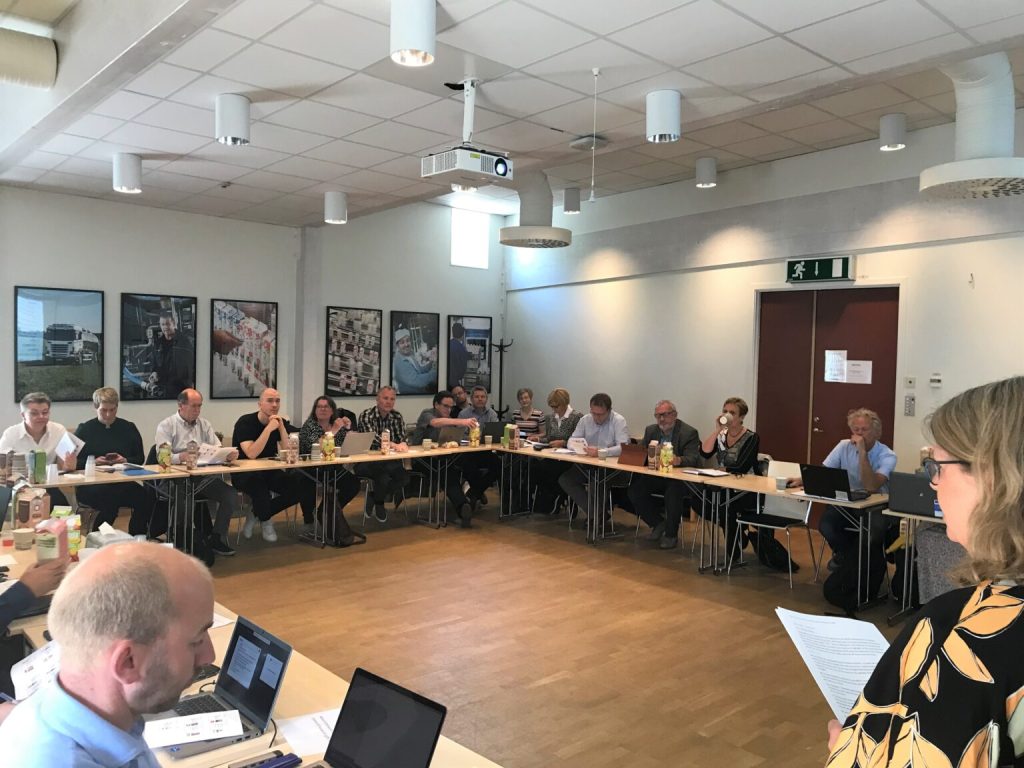
The first step in the project was taken in May, when all the partners met. As part of the project description, the participating countries have already identified their respective challenges and based on them, national efforts must now be initiated. Here, the partner countries will offer their expertise in the areas they themselves are strong in, so that cooperation is strengthened.
“It will create synergy, and then the countries can offer their experiences for inspiration and joint efforts, so that we don’t have to invent the deep dish everywhere.”
One of the concrete goals the project must fulfill is the development of a learning platform (Dairy Learning and Innovation Hub). The platform must contain the virtual learning material that the project partners develop during the four years. Among other things, there will be modules that focus on digital and green skills. The hope in the digital area is, for example, to be able to develop a 3D reality where the students can move into a production room and see what the different things are called and how they are used – as a reference work, Isabel Sande explains:
“That way, we can offer virtual training, so that you don’t necessarily have to be at the school to learn something that takes place in the Netherlands, for example. At the same time, you get the opportunity to solve problems virtually, so you don’t have to stand around and destroy an entire machine by trying your hand at it.”
Cooperation must create long-term results
On paper, the project is set to run until 2026, but according to Isabel Sande, the ambitions for the network extend further into the future:
“We want the working groups to exist, so that, in addition to the project period, you can continue to gain experience from each other and collaborate on the dairy training courses,” she says and elaborates:
“We are very different. The dairy education in Denmark is over 100 years old, and there are old traditions and a large network, in contrast to other countries, where there is hardly any cooperation with the industry. So there we also hope to help those who do not yet have the strong relationships at national level and to lift them up, so that the industry can see a greater point in collaborating with the educations”.
EU consultant Jens Bøgetoft Christensen from the South Denmark EU office has helped the application for the project along. He says:
“Centres of Vocational Excellence are EU cooperation at its best. Here, together with national experts and the Joint Research Center of the European Commission, an inspiring and practical model has been developed to both elevate our vocational training locally in the individual member states and at the same time make it easier to find employment and run a business across Europe.”
 SDEO Education