
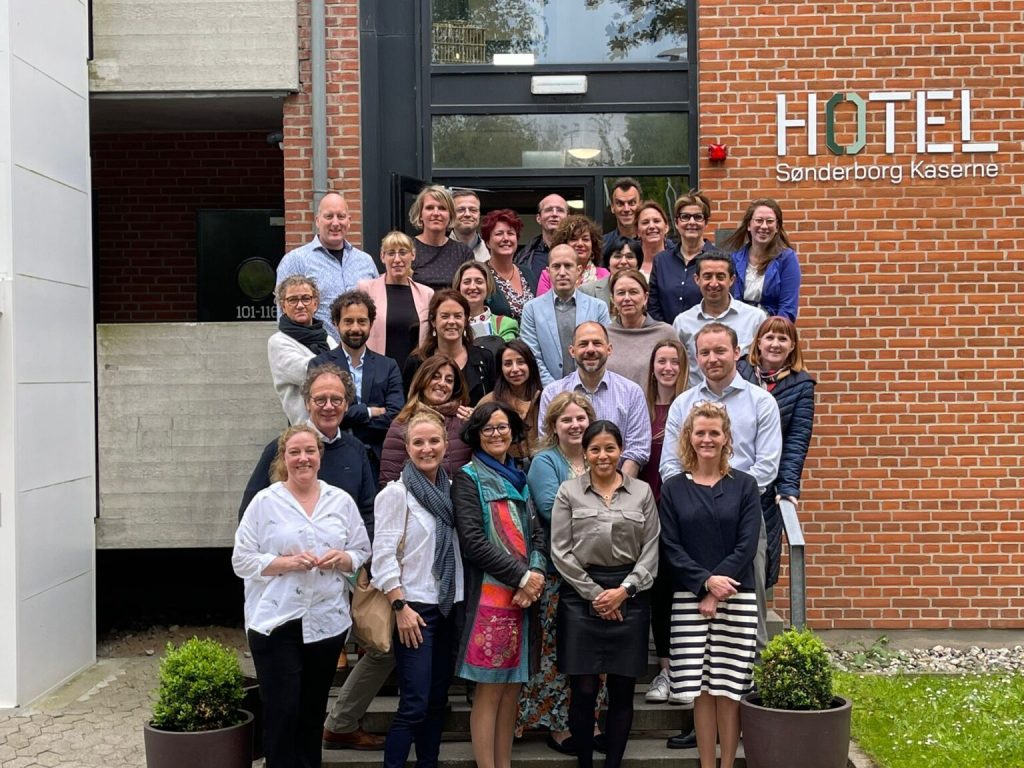
The hospital system is under pressure, and as the population ages, there is a need for more resources in the health sector. However, the lack of labor is great all over Europe, and now a comprehensive project with Sygehus Sønderjylland at the helm must investigate how to meet the challenge. The project is supported by Erasmus+ and has a total budget of 26 million DKK.
“We have a healthcare system in Europe today that is under tremendous pressure. We don’t have enough doctors and nurses. In our region, we can concretely feel that we cannot get our positions filled,” says Trine Ungermann Fredskild, chief consultant at Sygehus Sønderjylland about the EU project entitled EUVECA (European Platform for Vocational Excellence in Health Care).
Sygehus Sønderjylland and the South Denmark EU office are at the forefront of the project, which also has the participation of 14 southern Danish municipalities and UCL. In collaboration with 19 European players from the health sector, including health education programs, the project will investigate how to ensure sustainability with a focus on competence development in the health sector. The European participants are spread over seven countries and seven different regions. Each region must develop an “innovation hub” (an innovation center) in collaboration with their respective educational institutions, organisations, healthcare providers etc.
The results from the various hubs must result in a pan-European platform with measures for both continuing and continuing education of health professionals, but also for health education at University College, universities, social and health schools, and at the hospitals’ and municipalities’ own educational facilities.
The project has achieved 26 million DKK support from the CoVE initiative (Centres of Vocational Excellence) under the Erasmus+ programme, of which DKK 3.9 million DKK goes to the southern Danish partners.
Innovative health technology
Trine Ungermann Fredskild and project assistant Sabine Paasch Olsen both work at Sygehus Sønderjylland, and they experience the pressure in the health sector up close. They both point out that the project must, among other things, take a closer look at how to ensure that the health professionals become more innovative – especially when it comes to the use of health technology. Because even though the digital development within the healthcare sector is progressing rapidly, there is a need for proper implementation and the right skills to get the new solutions introduced effectively, explains Trine Ungermann Fredskild:
“There is still a part of the technology that is implemented in the healthcare system that never comes into use or that is only used sporadically and not with the technology’s full potential. This is often due to the staff having some workarounds made, so that you don’t really use the technology anyway, because it doesn’t fit into the workflow at the workplace. We must therefore also focus on work processes when we introduce new technologies”, emphasizes Trine Ungermann Fredskild.
For the EUVECA project’s partners, it is hoped that a pan-European platform with competence-developing and building material can be a part of overcoming the problem. First of all, however, it is important to meet the health professionals where they are, emphasizes Trine Ungermann Fredskild:
“We have a belief that if we go out and hold meetings and talk to the health professionals about what their needs are and maybe also go along and observe so that we see their work processes, then we also have a better foundation when we have to start planning the teaching and preparing the training material for them.”
Retention via competence building
In the EUVECA project, the aim is not to recruit new labor for the health sector in the first place, but rather to retain the one who is already there.
“It is a retention project – not a recruitment project”, says Trine Ungermann Fredskild and adds:
“We would very much like to make the continuous skills development so good that the older employees do not leave because, for example, they are insecure about using an app for tasks that they have always solved in a different way. Unfortunately, that is what we see today. We cannot afford to lose that generation just yet. Partly because there is not enough manpower, and partly because they have knowledge that we cannot do without.”
Cooperation across borders
An important part of the EUVECA project is the cooperation across national borders. Because even though each region develops its own training material, it is all brought together on the pan-European platform so that everyone can enjoy and be inspired by each other’s results.
“With the platform, we create an ecosystem across Europe, where you can be inspired by each other’s different ways of working and benefit from the knowledge that comes in across countries and regions,” says Sabine Paasch Olsen.
At the same time, one of the cornerstones of the project is its strong focus on e-learning. All material on the platform must thus be flexible and easily accessible so that it can be shared between the different countries.
“We have an assumption that if we can get away from the traditional classroom mindset and make things more accessible and adapted to the health professionals’ needs, then maybe we can hit something right,” explains Trine Ungermann Fredskild.
Therefore, it is also the hope of the partners that the EUVECA project can contribute to increasing competence development among health professionals, so that the sector is better equipped to, among other things, implement the digital tools of the future.
“I hope that we will achieve that the pan-European platform provides some new learning perspectives on competence development in the healthcare system. Some new tools and perspectives,” concludes Trine Ungermann Fredskild.
At the South Denmark EU office, EU consultant Henriette Hansen looks forward to being part of the project over the next four years. According to her, the fact that the Region of Southern Denmark and Sygehus Sønderjylland have now become lead partners on a CoVe project within the health sector harmonizes very well with the fact that the region has for several years been a so-called “reference site” within the European Innovation Partnership for Active and Healthy Aging (EIPonAHA):
“For the past ten years, Region Southern Denmark as a reference site has shown how to be at the forefront in relation to the implementation and scaling of digital solutions. We are now using that experience to ensure that the competence development of the current and future workforce in the health sector is also on the European agenda. The Region of Southern Denmark is once again the leading region”.
Southern Danish municipalities that will participate in the project: Odense, Nyborg, Kerteminde, Svendborg, Kolding, Billund, Varde, Middelfart, Esbjerg, Tønder, Haderslev, Aabenraa, Vejle and Sønderborg Other consortium (19 partners in total): European Connected Health Alliance, European Special Nurse Organisation, European Health Management Association and regional partners (educational institutions and healthcare providers) from the Netherlands, Norway, Slovenia, Spain, and Italy.
 SDEO Education